


Forum Replies Created
-
AuthorPosts
-
in reply to: Stacking fixes? #43700
No, I’m afraid YOU can’t. You might or might not be able to send it out to a “bow doctor” and get it done, but for an old factory bow that had little market value, I doubt it’s worth the money, esp. when you consider that with a lighter bow (result of weakening the limbs) you’ll likely need to start all over with new arrows, etc. I’d suggest you start shopping for a longer bow and/or one designed esp. for long-draw shooters. Keith Chastain in Colorado is one bowyer who specializes in such, being a “stretch” himself. Good luck.
in reply to: Grizzlies tuffheads and tuskers #42468I assume we are talking about the Tusker Concord? If so, I’m with L82HUNT right down the line. The Tuffheads are expensive, the Tuskers a relative bargain, and the new Grizzlies, if they ever get on the shelves, are unbelievably cheap, at least for now … thus, if economy is an issue I’d go with the Grizzly over the Tusker, though both are excellent. But the Tuffhead is money well spent, unless you take long wild shots and lose lots of arrows. 😛 Aside from the Tuffhead’s excellent factory sharpening, overall Ashby-quality design (high MA) and toughness, I love the long slender shape that won’t windplane even in wind, and they’re a thicker head than either the Grizzly or Tusker. And for single-bevels the thicker the head the wider the bevel shelf and the greater the torque, esp. going through bone. YOu can hardly go wrong with any of these three great heads but I’m a Tuffhead guy until something better comes along for less money, and I’m not holding my breath. Shot plumb through a bull elk with one last year (from a 53# bow) and hope to repeat this year with wood arrows rather than carbon.
in reply to: Calculating FOC: question for Dr. Ashby #40917Thanks, Ed and everyone. It seems clear that most here are happy with the AMO method (shaft length measured to BOP) with its higher FOC numbers. So, going with that, and with two measurements coming out the same, I guess I can honestly say that I have 23.73% FOC with wood shafts and 300 Tuffheads, which–given the limits on wood shaft weight vs. spine, and the difficulty Fletcher had in finding just nine shafts (took months of saving them back)that would give 85# spine in a relatively light shaft (average about 410), I don’t think we’re going to do much better with woods. If I don’t break them all in practice, I plan to kill an elk with this set-up this year and predict a full pass-through, though 23/64 shaft diameter is a disadvantage over skinny carbons.
Coincidentally, Fletcher fletched these with 4×2″ feathers, my first experience with four-fletch, and I’m so please I plan to make it my norm henceforth–though it might be tough getting four feathers on a skinny carbon shaft.
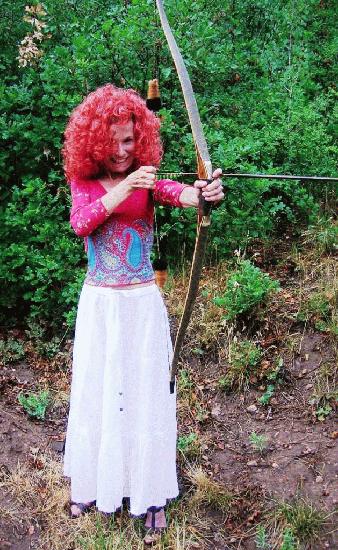
in reply to: "Brave" review #39677HEY, THANKS TO A FRIEND WHO WORKS AT PIXAR STUDIOS, I GOT MY MERIDA! COINCIDENTALLY, THIS IS VERY CLOSE TO HOW CAROLINE’S HAIR ALWAYS LOOKED WHEN WE LIVED ON THE OCEAN, ONLY SHE IS A BLONDE. WHEN WE MOVED TO THE ARID SW IT WENT DEAD STRAIGHT. IT’S ALL GOOD FUN, ESPECIALLY AS WE AGE. WE’RE ONLY AS OLD AS WE FEEL AND ACT. 😀
 in reply to: Calculating FOC: question for Dr. Ashby #38360
Steve — You make good points re relativity. While I fail to see that anything can be learned from faulty data, here are the original numbers you requested:
23.33 = field point, BOP
15.63 = including field point
23.73 = broadhead, BOP
21.21 = BH included
One more, perhaps minor potential for inconsistency: Using the FOC chart we often have to round up or down. I always round up but can’t say why.
in reply to: Calculating FOC: question for Dr. Ashby #37165Responding to your good points and questions: Balance point is almost identical, with field point only 1/8″ forward of broadhead.
More importantly, I ran the measurements and calculations again and apologize for incorrect numbers the first time. The figures in my initial post have been corrected. Turns out the figures for both arrows measured to BoP are correct, but the figures including points were off for both arrows. Don’t know how that happened but I double-checked this time and should have the first time. So now what we see is that FOC for both arrows and both type heads is notably higher when measured to BoP than when including head length. Now, with both field points and broadheads I have much better FoC when measured without heads than with.
So, to bring us back to the beginning: I am using personal examples but this is not about me: The question is for all of us, and it is this: Because we seek a minimum of 20% FoC and the two measuring methods result in “below minimum” when measured with head and “above minimum” when measured to BoP, which is most accurate, reliable, usable, etc.? Would it make any sense to average the two?
in reply to: Calculating FOC: question for Dr. Ashby #36377Yep. As the mountain men are said to have said when confused, “It’s too many for me!” Happily, I scrape by either way with the broadhead, but am left to wonder why FOC is so much lower on the field point when measured to include head length … likely because the field point is an inch shorter. We’ll just have to await input from the Big Boys. I think I see one coming now and he looks serious …
 in reply to: Building EFOC/UEFOC hunting arrows #35827
Jans — I use the CE250s with 450 grains up front: 225 Tuffhead with 100 grain adapter and 125 grain insert. The shafts weigh about 350 and I total out just below 800 total. But this is an elk setup that I never shoot beyond 20 yards … it’s my shooting skill that limites me more than any trajectory problems.
For deer, antelope, turkey etc. I drop back 100 grains or more in head weight but not sure why.
I know there are many far superior carbon shafts out there but I know nothing about them. Being a very reluctant carbon shooter, I somehow got started with CEs and since they work I’ve stuck with them. Many folks here know more about the various carbon options than I do. While you don’t need a heavy arrow set-up for pronghorn, so long as it shoots to your satisfaction “there’s no such thing as over-kill” in hunting arrows, while opportunities for being under-gunned lurk behind every magazine advertisement (except TBM of course). 😀
in reply to: Wood, Woody weights, high FOC, etc. #34970Tom, I second you talking to Rick Stillman, aka Fletcher, at The Feathered Shaft in IL: http://www.thefeatheredshaft.com. I just received a dozen Sitka spruce arrows from him set up for 300-grain heads, which I’ll be playing with in the coming days and reporting on here (53# longbow drawn to 28″ needs 85# spine shafts). They should deliver 20% FOC or higher, depending on how you measure it (with or without the head, which we also need to discuss here). The problem is finding wood shafts that are stiff enough to handle the big heads, but don’t weigh-in like torpedoes.
So far as Woody Weights, I don’t wish to say “they’re no good,” but feel obligated to report that in my testing they did tend to break loose from the steel point, broadhead or field head, when shot into trees(poor man’s attempt to replicate a heavy bone hit) at an angle. So I don’t use them for hunting. However, I’m overdue to try ’em again as I’m far more careful about cleaning and scoring steel-to-steel glue-ups nowadays.
And you came close to providing the most succinct explanation of why “If it ain’t broke, don’t fix it” is a false lead for trad bowhunters. Few would disagree that the perfect shot, aside from placement, is a full pass-through. I say, if your current set-up doesn’t consistently produce full pass-throughs on the game you hunt, it’s broke and in need of fixing. I long ago had a problem with lame penetration even when shooting much heavier bows. Following the Ashby advice has fully fixed the problem, and I hunt mostly elk. So don’t be turned-around by the nay-sayers. You’re on the right track. And much as I prefer to shoot woodies, if I feel I have to use carbons to get the overall weight and FOC I need to feel confident of rifle-fast kills, well that comes first as I personally feel I owe it to the beautiful wild animals I hunt. 😀
in reply to: String action #33908Lucky timing indeed,Ralph. Sort of like the archer’s paradox scene in “Brave.”
in reply to: Building EFOC/UEFOC hunting arrows #33836A decent “economy” shaft is the Carbon Express, which takes all standard internals. I’ve killed a couple of elk with them and a deer and never had one fail. I’m shooting around 27% FOC with these.
in reply to: how many arrows for hunting? #33518Four broadheads in bow quiver, or when elk hunting in grouse country, 3 broadheads and one Ace hex-head blunt. Back in the truck or camp I have plenty of backups.
in reply to: Wood and FOC #29954Scout– Those are my (forthcoming) arrows Fletcher is talking about. I have always included point length in FOC calculations and would love to hear Ed Ashby chime in here on the topic. Maybe for this forum we can all agree on FOC including point length? While I would rather have a total weight down closer to 650, even for elk, these 715s are lighter than most carbon arrows set-ups I’ve used with FOC beyond 20 percent. They will do nicely for elk, which is the plan, but I prefer lighter arrows for deer, etc., but still no less than 650. I’ve been shooting heavy, high-FOC arrows for so long that I don’t even notice any increased trajectory. Anyhow, that’s my elk arrows for this year–what Fletcher describes with a 300 Tuffhead.
in reply to: First Osage Bow **Updated w/ Pics** #25694Jeremy, your problem is absolutely common to beginning bowyers, myself definitely included. Thus do we accidentally build a lot of “kids” bows. 😛 Depending on a lot of things, it’s possible to get the draw weight up to where you want it by cutting the limb tips to make the bow shorter. But this only works if you have a pretty long bow to start with, and there’s always the danger of falling into the “leveling the table legs” trap. But a thought worth entertaining, at least. Purdy bow you have there.
in reply to: Looking for Staves in Colorado #24599Actually guys, I mean Vol. 1 (nor corrected in my original post). Just forgot to put the space in the V. 1 😛
-
AuthorPosts
